 d83a843679
* add extra tests for windows on azure * fix login * fix login * fix login * change to pull_request_target for now * refactor: change workflow trigger from pull_request_target to pull_request * update checkout fix * wait for ssh * fix clean up * Fix Windows E2E test output processing by wrapping it in a powershell command and simplify Azure stack name generation. * Fix Windows E2E command quoting * Fix minikube binary path for Windows E2E tests * apt update background * chore: Add `-tt` flag to ssh command in extra-tests workflow. * ci: install kubernetes-cli via choco in extra-tests workflow. * fix: Execute `choco install kubernetes-cli` remotely via SSH in the extra-tests workflow. * use more gh actions * update * ci: add Bicep template file to Azure ARM deployment action in extra tests workflow * ssh keep alive * test: Ensure absolute path for linked kubectl binary and add error handling in functional test. * Generate Gopogh reports on the Linux runner for Windows E2E tests, remove VM-side tool installation, and enhance artifact uploads with detailed summaries. * ci: Copy `test/integration/testdata` to the Windows host for extra tests. * add more comments * fix: Ensure error is non-nil before warning about unexpected machine state. * refactor: Rename workflow to 'Functional Extra' and job to 'windows-hyperv'. * create shared composite github actions * fix: add checkout to functional_test job * fix local gh action * fix: Adjust indentation of `uses` keywords for gopogh actions in functional_test.yml. * fix name * fix: Correct YAML formatting for the 'Install Gopogh' action in functional_extra.yml. * remove extra gopogh environment variable |
||
|---|---|---|
| .devcontainer | ||
| .github | ||
| .openvex/templates | ||
| cmd | ||
| deploy | ||
| enhancements | ||
| hack | ||
| images/logo | ||
| installers | ||
| pkg | ||
| site | ||
| test | ||
| third_party | ||
| translations | ||
| .codecov.yml | ||
| .dockerignore | ||
| .gitattributes | ||
| .gitignore | ||
| .gitmodules | ||
| .golangci.max.yaml | ||
| .golangci.min.yaml | ||
| .golangci.yaml | ||
| .markdownlint.json | ||
| CHANGELOG.md | ||
| CONTRIBUTING.md | ||
| LICENSE | ||
| Makefile | ||
| OWNERS | ||
| README.md | ||
| SECURITY-INSIGHTS.yml | ||
| SECURITY.md | ||
| SECURITY_CONTACTS | ||
| code-of-conduct.md | ||
| go.mod | ||
| go.sum | ||
| netlify.toml | ||
| sonar-project.properties | ||
| test.sh | ||
README.md
minikube





minikube implements a local Kubernetes cluster on macOS, Linux, and Windows. minikube's primary goals are to be the best tool for local Kubernetes application development and to support all Kubernetes features that fit.
Features
minikube runs the latest stable release of Kubernetes, with support for standard Kubernetes features like:
- LoadBalancer - using
minikube tunnel - Multi-cluster - using
minikube start -p <name> - NodePorts - using
minikube service - Persistent Volumes
- Dashboard -
minikube dashboard - Container runtimes -
minikube start --container-runtime - Configure apiserver and kubelet options via command-line flags
- Supports common CI environments
As well as developer-friendly features:
- Addons - a marketplace for developers to share configurations for running services on minikube
- NVIDIA GPU support - for machine learning
- AMD GPU support - for machine learning
- Filesystem mounts
For more information, see the official minikube website
Installation
See the Getting Started Guide
📣 Please fill out our fast 5-question survey so that we can learn how & why you use minikube, and what improvements we should make. Thank you! 👯
GitHub Codespace
You can run minikube in a GitHub Codespace by clicking here:

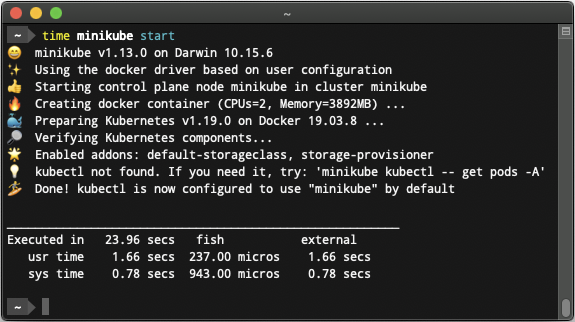
This will launch a Github Codespace. You can then run minikube start and minikube dashboard - You can then open Minikube Dashboard by clicking opening the link displayed in the terminal.
You can also run Minikube in a Dev Container locally using your favorite IDE, for more information see Dev Containers https://code.visualstudio.com/docs/devcontainers/containers
Documentation
See https://minikube.sigs.k8s.io/docs/
More Examples
See minikube in action in the controls handbook
Governance
Kubernetes project is governed by a framework of principles, values, policies and processes to help our community and constituents towards our shared goals.
The Kubernetes Community is the launching point for learning about how we organize ourselves.
The Kubernetes Steering community repo is used by the Kubernetes Steering Committee, which oversees governance of the Kubernetes project.
Community
minikube is a Kubernetes #sig-cluster-lifecycle project.
-
#minikube on Kubernetes Slack - Live chat with minikube developers!
Join our community meetings: